

My iTech Holding – My iCoffee: Elevating Minas Gerais’ Arabica Coffee to Global Excellence.
Minas Gerais, Brazil, is globally recognized as a coffee powerhouse, producing some of the finest Arabica coffee grains in the world. At the forefront of innovation in coffee technology and grain excellence is My iCoffee, a company dedicated to revolutionizing the coffee industry. Under the visionary leadership of Igor Amorim Renha, Famíglia Luisetto & Galliazzo, an Italian-Brazilian entrepreneur, My iCoffee is setting new standards in the cultivation, processing, and technology of premium Arabica coffee beans.


The Secret Behind the Best Arabica Coffee Grains
Arabica coffee (Coffea arabica) is revered for its superior taste, delicate aroma, and balanced acidity. The beans from Minas Gerais benefit from the region’s high-altitude plantations, ideal climate, and rich soil composition, which contribute to their exceptional quality. Mi Tech Coffee leverages cutting-edge agricultural techniques and advanced processing methods to ensure that every batch of coffee retains its complex flavor profile and aromatic richness.
Key Factors That Make Mi Tech Coffee’s Arabica the Best:
- Altitude & Climate: Grown at elevations above 1,000 meters, the beans develop more sugars, enhancing their sweetness and flavor complexity.
- Selective Harvesting: Only the ripest cherries are handpicked to ensure uniformity and the highest quality.
- Advanced Processing: The company employs innovative fermentation techniques, controlled drying, and precision roasting to preserve the beans’ natural characteristics.
- Sustainable Practices: My iCoffee prioritizes environmentally friendly farming and ethical sourcing to support local farmers and maintain biodiversity.
A Visionary Leader: Igor A. Renha (Famíglias Luisetto & Galliazzo)

 Igor, the CEO of My iTech Coffee, brings a wealth of expertise and a passion for excellence. As a dual citizen of Italy and Brazil, he merges the rich traditions of Italian coffee culture with Brazil’s vast coffee-growing heritage. His mission is to elevate Minas Gerais’ coffee to its rightful place on the global stage, making it a benchmark for quality and innovation.
Under his leadership, My iCoffee is not only delivering an outstanding product but also investing in research, sustainable agriculture, and technology to refine every step of the coffee-making process. His commitment to excellence has positioned Mi Tech Coffee as a key player in the international coffee market.
Certificate of participation or conclusion 
SENAR (National Service for Rural Learning) in Brazil offers courses in coffee classification and tasting and provides a certificate of participation or conclusion for these courses, like the Coffee Quality Institute (CQI) or the Specialty Coffee Association (SCA).
- Course Provider, Not a Primary Certifier: SENAR provides valuable professional training for the Brazilian agricultural sector, including specific courses on coffee tasting and classification, often in partnership with rural unions and other entities.
- National Recognition: These courses are well-regarded within Brazil and the local coffee industry, and ex-students have gone on to win national tasting competitions.
- International Standards: The internationally recognized certifications for coffee tasting are the Q-Grader (for Arabica coffee) and R-Grader (for Robusta coffee) certifications, issued by the Coffee Quality Institute (CQI) and based on the Specialty Coffee Association (SCA) methodology.
- BSCA Partnership: The Brazil Specialty Coffee Association (BSCA) is the official representative in Brazil for these international certifications (CQI/SCA) and is the only association that certifies the quality and sustainability of coffee in Brazil according to these global standards.
- Industry Events: SENAR is actively involved in major coffee events and competitions in Brazil, such as the “Coffee Of The Year” contest and the International Coffee Week (SIC), where these certifications and quality standards are widely used and recognized.
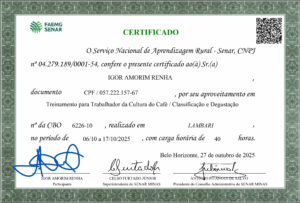 In essence, while you can take a high-quality, locally recognized course with SENAR, to be a “certified coffee taster” with an internationally recognized qualification, you would pursue the Q-Grader or R-Grader license through an authorized organization like the BSCA in Brazil.
 The Future of Coffee Technology
My iCoffee is more than just a coffee producer; it is a technology-driven company focused on enhancing the entire coffee supply chain. By implementing state-of-the-art roasting machines, AI-powered quality control, and blockchain transparency in sourcing, the company ensures that every cup brewed from its beans is a masterpiece.
With an unwavering commitment to innovation and quality, My iTech Coffee is poised to redefine the global coffee industry. Minas Gerais’ Arabica coffee, perfected through technology and expertise, is now the gold standard for coffee lovers worldwide.
For those who seek the best in coffee, Mi Tech Coffee delivers an unparalleled experience-one that embodies passion, precision, and the rich heritage of Brazilian coffee culture.
 My iCoffe Brand control – My iTech Holding

Arabica coffee production process, score 8.4
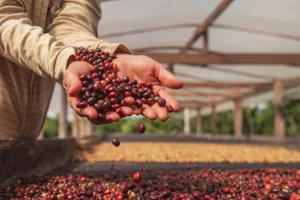
The production of an Arabica coffee with a score of 8.4 on the scale of the Specialty Coffee Association (SCA) requires a meticulous process focused on quality at every stage, from cultivation to roasting. Below are the main steps to achieve this score, which classifies it as a high-quality specialty coffee.
Ideal Terroir: The 8.4 rating is influenced by the terroir, which includes altitude, climate, soil, and the variety of Arabica coffee. Coffees grown at higher altitudes, such as those in the Mantiqueira de Minas or Chapada de Minas regions, tend to develop more complex flavors and pleasant acidity.
. Careful Management: This includes precise fertilization, pest and disease control, and systematic pruning to ensure the health and vitality of the plants. The ideal temperature for cultivation ranges between 18°C and 23°C, avoiding extreme heat that can harm the development of the beans.
. Perfect Ripening: To achieve a high score, harvesting must be selective and manual, done at the peak of fruit (cherry) ripeness, when they are red and sweet. Selective harvesting prevents green or overripe beans from compromising the quality of the batch.
The processing method is crucial in defining the sensory profile of coffee. The most commonly used techniques for specialty coffees are:
Dry (natural) process: Whole cherries are sun-dried on patios or in mechanical dryers. This process allows the sugars in the pulp to be absorbed by the bean, resulting in a fuller-bodied and sweeter beverage. Drying must be slow and controlled, with constant stirring to avoid unwanted fermentation.
Wet (washed) process: The cherries are hulled and the pulp is removed before drying. The beans undergo a controlled fermentation process in tanks and are washed to remove any remaining mucilage. This method produces coffees with higher acidity and a cleaner flavor.
Natural pulped: This is a hybrid method where the pulp is partially removed, leaving the mucilage intact for drying. This results in a coffee with balanced sweetness and body.
Moisture control: After processing, the grains are slowly dried until they reach the ideal moisture level (between 11% and 12.5%). Drying can be done on patios (in the sun) or in mechanical dryers, with the temperature controlled to preserve the integrity of the grains.
Grain Standardization: Dried coffee is processed to remove the hard husk (parchment) and the silvery film. Then, it is classified by size and density to create homogeneous batches.
Defect Analysis: The beans are inspected to remove defects that could affect the cup score. For scores above 84, the batch should have as few defective beans as possible.
Quality preservation: Green coffee is stored in clean, well-ventilated environments with controlled humidity, away from odors and substances that could contaminate it. Jute bags with high-barrier packaging are frequently used to protect the beans.
Flavor Development: For specialty coffees, roasting is done by professionals who adapt the roasting profile to enhance the sensory characteristics of the bean. A well-controlled roast is essential for developing flavor and aroma.
Professional Evaluation: The coffee batch only receives a score after sensory evaluation by certified tasters (Q Graders). They analyze attributes such as fragrance and aroma, flavor, finish, acidity, body, balance, sweetness, and absence of defects.
SCA Score: A coffee with a score of 84 is classified in the range of 80 to 84.99 points, indicating a good quality specialty coffee, clean and with pleasant sensory characteristics.